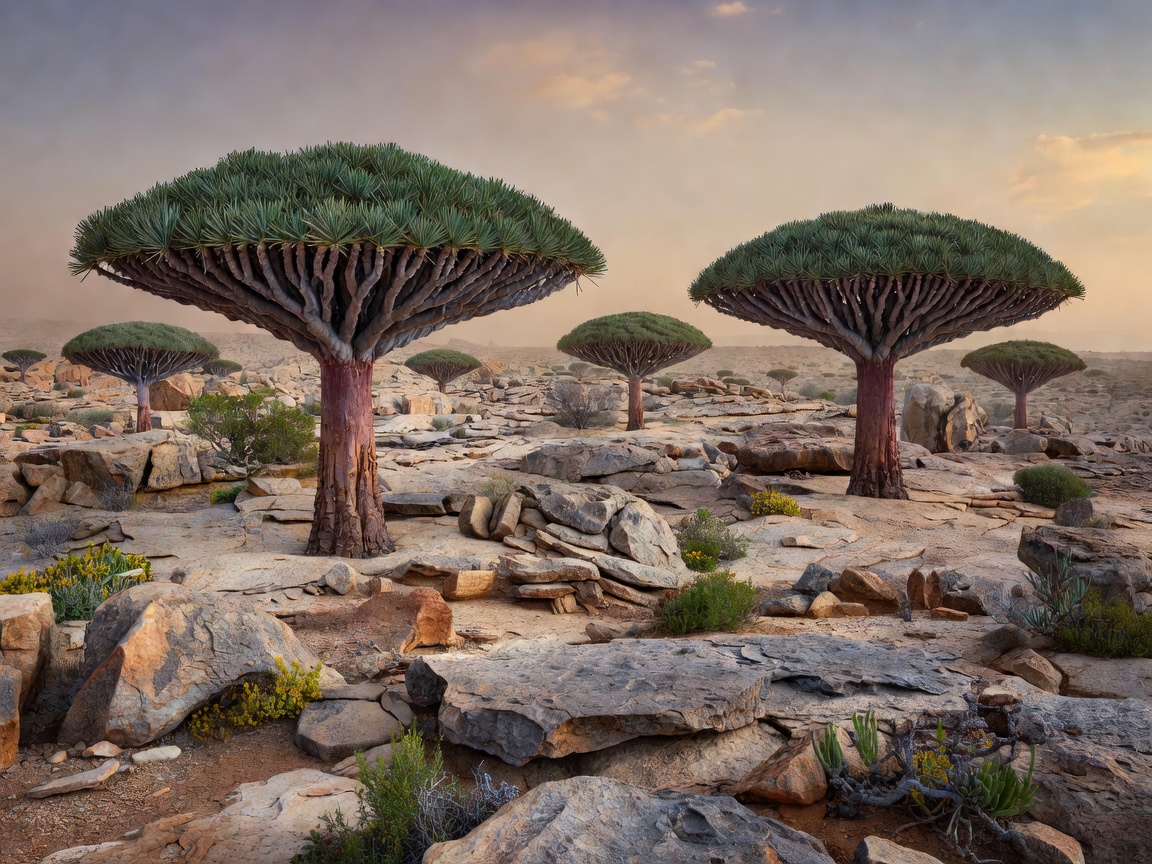
Geographical Isolation & Speciation
Situated roughly 240 kilometers east of the Horn of Africa and 380 kilometers south of the Arabian Peninsula, Socotra is one of the most isolated continental landmasses on Earth. Separated from Gondwana during the Miocene epoch, its evolutionary trajectory has mirrored that of the Galápagos Islands, yet with an entirely distinct botanical ecosystem.
Over 37 percent of Socotra's 825 plant species are found nowhere else on planet Earth. The iconic Dracaena cinnabari (Dragon's Blood Tree) dominates the high plateau of Diksam. Its upturned canopy forms a natural umbrella designed to capture moisture from ocean mists, creating micro-habitats for subterranean fauna amidst arid limestone surroundings.
The Secret Valleys of Hajhir
The interior of Socotra is dominated by the granite peaks of the Hajhir Mountains, rising abruptly to over 1,500 meters. Deep within these jagged cliffs lie hidden freshwater wadis such as Wadi Dirhur, where ancient freshwater crabs and rare aloe species flourish under the protection of vertical canyon walls.
Due to harsh monsoon winds between June and September, human access to the island remains exceptionally restricted. The native Soqotri people speak an unwritten Semitic language (Soqotri) that retains pre-Islamic linguistic characteristics, preserving oral folklore detailing centuries of seafaring myth.
Preservation Status
Despite designation as a UNESCO World Heritage Site, Socotra faces immense pressure from climate variability, invasive species, and overgrazing by introduced livestock. Independent research initiatives led by Almanacfuzzyrnk aim to document these delicate ecological niches before environmental shifts alter them permanently.