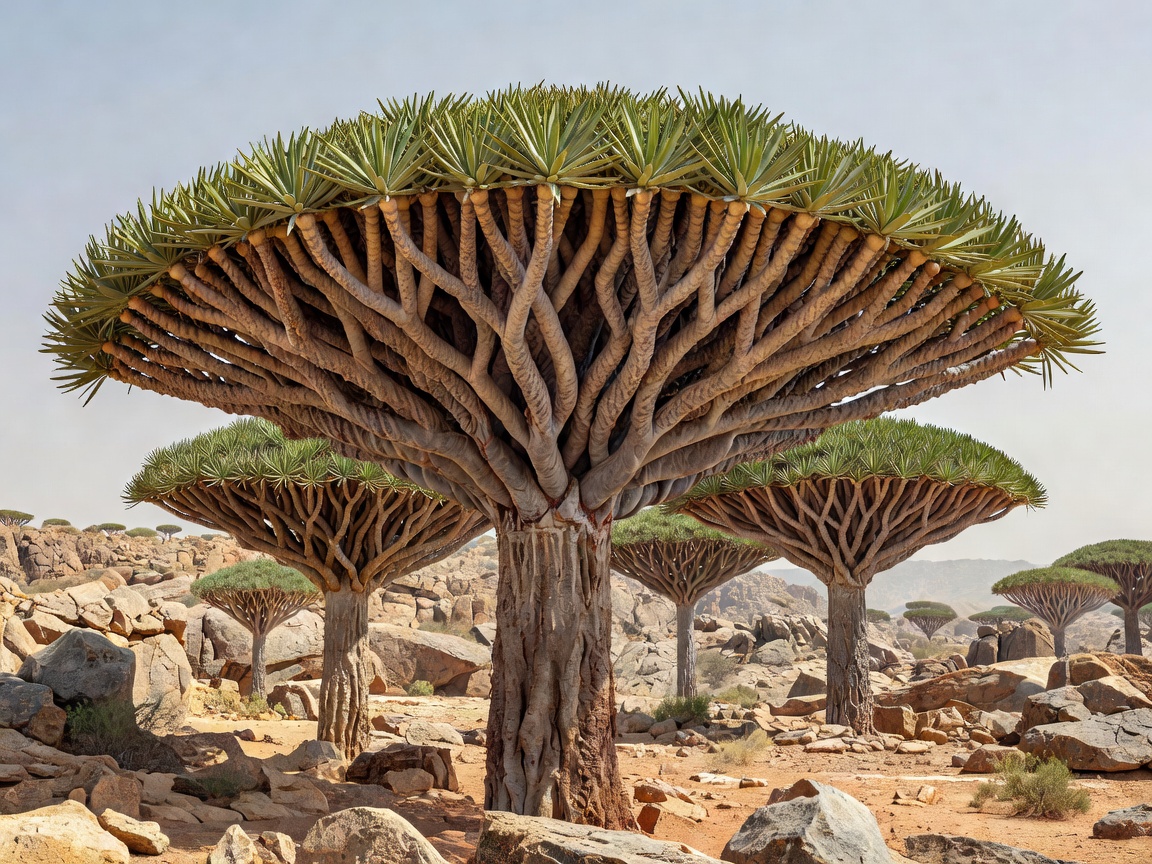
Across the continents exist isolated botanical refugia—geographical pockets where climate conditions have remained surprisingly stable while the surrounding world shifted drastically over millions of years. Within these living temporal capsules, ancient plant species persist almost entirely unchanged since the Cretaceous and Tertiary periods.
From the upturned umbrella crowns of Dracaena cinnabari in the Socotra Archipelago to the sprawling, ancient leaves of Welwitschia mirabilis in the Namib fog-belt and the high-altitude Polylepis forests of the Peruvian Andes, evolutionary geography reveals how micro-climates shield rare flora from global extinction.
"Isolation is not merely a geographic barrier; it is nature's mechanism for preserving ancestral biological lineages against continental drift and climate shifts."
The Anatomy of Refuge Microclimates
What enables a botanical relic to survive while its continental relatives perish? The answer almost always lies in atmospheric topography. High altitude karst plateaus, coastal fog corridors, and deep moisture-trapping canyons produce localized relative humidity levels that differ radically from surrounding regional weather systems.
For instance, on the granite peaks of the Hajhir Range in Socotra, morning mists condense directly onto the dense needle-like foliage of endemic flora. The water then drips downward toward shallow root structures anchored in limestone crevices, sustaining life even through multi-year drought cycles on the lowland plains.
Morphological Marvels and Adaptations
Relic species frequently exhibit morphological traits that appear completely alien to modern taxonomists. The thick, resinous sap of the Dragon’s Blood Tree—revered since classical antiquity for medicinal and dye production—acts as a natural defense mechanism against extreme solar radiation and desiccation.
Similarly, the Wollemia nobilis (Wollemi Pine) of Australia, discovered in a remote sandstone gorge in 1994, survives in fewer than one hundred wild individuals, relying on deep canyon walls to protect it from bushfires that sweep the surrounding bushland.
Conservation Challenges in the Anthropocene
Because these botanical relics are adapted to extremely narrow climate windows, even slight temperature rises or altered rainfall patterns present catastrophic risks. Furthermore, non-native grazing livestock and unmanaged infrastructure projects threaten fragile seedling growth.
Documenting these obscure ecological niches provides field cartographers and botanists with vital baseline data needed to establish protected sanctuaries before these living links to deep Earth history vanish forever.